Case Study
Precision Distribution
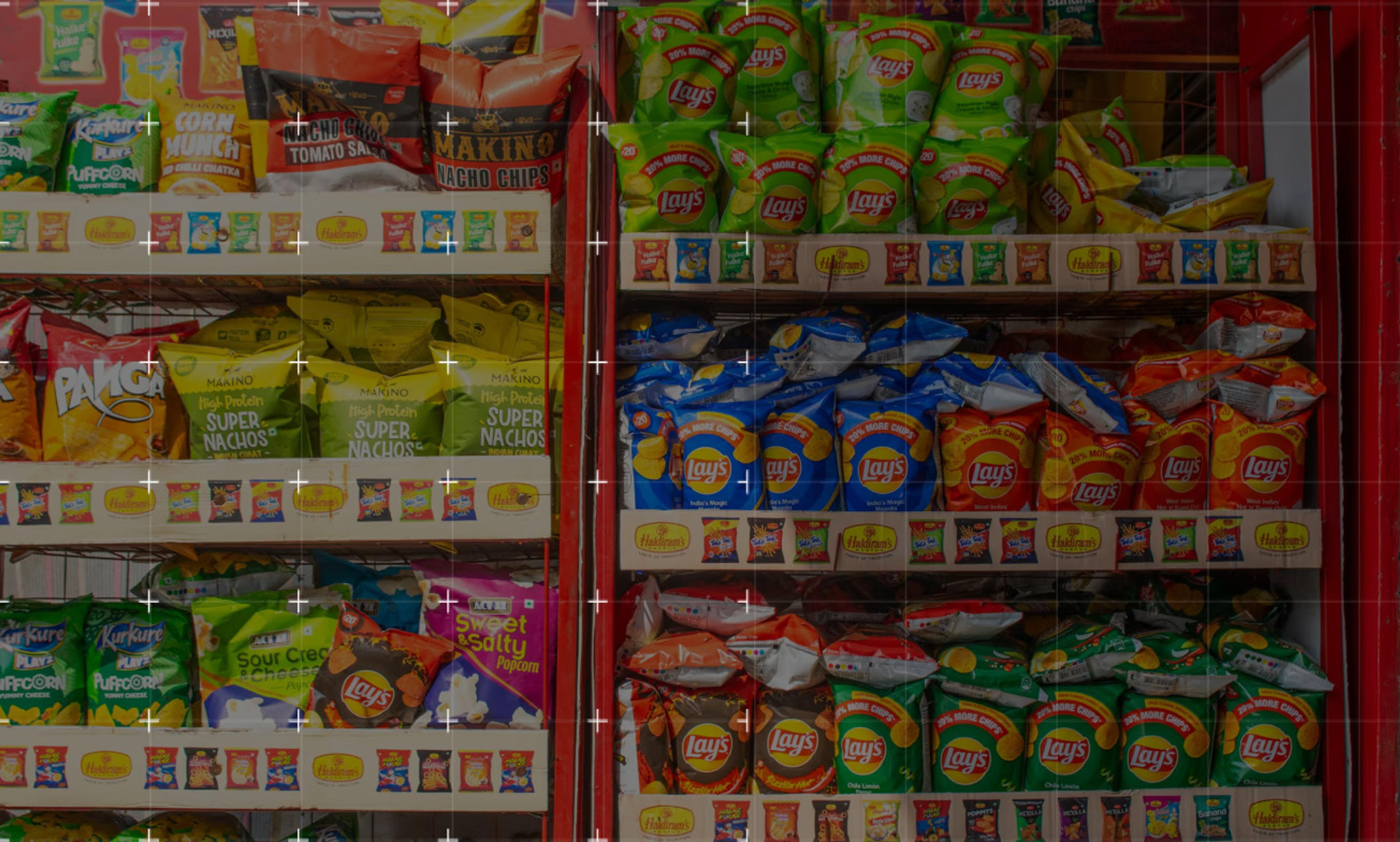
Securing shelf space through hyperlocal POS targeting in high-potential neighborhoods
Significant distribution growth
for secondary portfolio brands
Activation of
34 key micro-zones
prioritized by POS concentration and frequency.
Greater
territorial control
ensuring execution where returns were maximsed.
Executive Summary
The salty snack market is unforgiving—dense competition, limited shelf space, and constant pressure at the point of sale. Growth is won or lost in-store.
For a global manufacturer, broad expansion wasn’t enough. The path forward was precision: extend distribution beyond the core category by targeting high-potential neighborhoods where demand signals, competitive gaps, and execution conditions aligned.
Not more coverage—better coverage. Identifying where incremental facings, adjacencies, and portfolio breadth would convert into share, and focusing execution there to secure space and sustain growth.
[01]
Challenge
While the manufacturer’s core brands dominated the category, the rest of the portfolio remained under-deployed across their footprint—low penetration, limited visibility, and little share of shelf in the neighborhoods that mattered most.
For this team, expansion beyond the core category had become blunt. Distribution targets were set broadly, with limited ability to distinguish where incremental SKUs would actually convert into share. High-potential neighborhoods were difficult to isolate with confidence, and prioritization broke down as conditions varied store by store.
The result was persistent drag on growth. Sales teams were active, coverage was high, but effort wasn’t landing where it counted. Portfolio SKUs that should have expanded presence in-store were inconsistently placed or absent altogether. In some neighborhoods, the opportunity was clear but under-executed. In others, time and visits were over-allocated with little return.
At its core, the team lacked a reliable way to continuously pinpoint where the full portfolio had the right to win and to translate that into focused execution. Visit frequency, POS management, and shelf strategy were set at a broad level, with limited ability to adapt to shifting conditions on the ground—leaving performance constrained by how decisions were made, not by the underlying market opportunity.
[02]
Solution
Through Native, Commercial and GTM teams have effectively moved from broad distribution assumptions to continuous, precision-led execution:
They systematically classified portfolio opportunities—not just by category, but by where each SKU had the right to win across their footprint. Core brands, adjacency plays, and long-tail SKUs were mapped against real in-store conditions, creating a clear view of where expansion would convert into share.
They operationalized micro-segmentation at the neighborhood level, translating opportunity into action. Visit frequency, store prioritization, and execution focus were no longer static plans—they were continuously recalibrated based on where opportunity density was highest, ensuring effort was applied with granularity and intent.
Users within their teams use the strength of the core brand as a wedge at the shelf—securing and expanding presence for adjacent SKUs within the same point of sale. Rather than competing for space SKU by SKU, the portfolio was deployed cohesively, turning existing dominance into a platform for broader expansion.
This is not a one-time reset. The system continues to learn and adjust as conditions shift—refining segmentation, reprioritizing neighborhoods, and directing execution in near real time. The result is a distribution strategy that compounds: more precise placement, more efficient coverage, and sustained portfolio expansion at the point of sale.
[Explore other Case Studies]

01
Home Care
Accelerating cross-category growth for an HPC manufacturer in Colombia through geographic and distributor prioritization
Find out more
02
Alcoholic Beverages
Achieving a 48% monthly growth rate in a secondary category within the alcoholic beverages sector by capitalising on the brand's core category points of sale.
Find out more